You’ve spent months on your nonfiction book. Somewhere in it, you quoted a historian, cited a statistic, or referred to a study. Sooner or later, a reader is going to wonder: Where did that come from?
Notes and a bibliography answer that question. They’re also among the first things an editor, publisher, or reviewer checks to see whether a nonfiction book is built on solid ground.
This post explains what notes and bibliographies are, why your book needs them, and how the Chicago Manual of Style handles them. Sample CMOS citations for the most common source types are at the end, so you can copy the pattern.
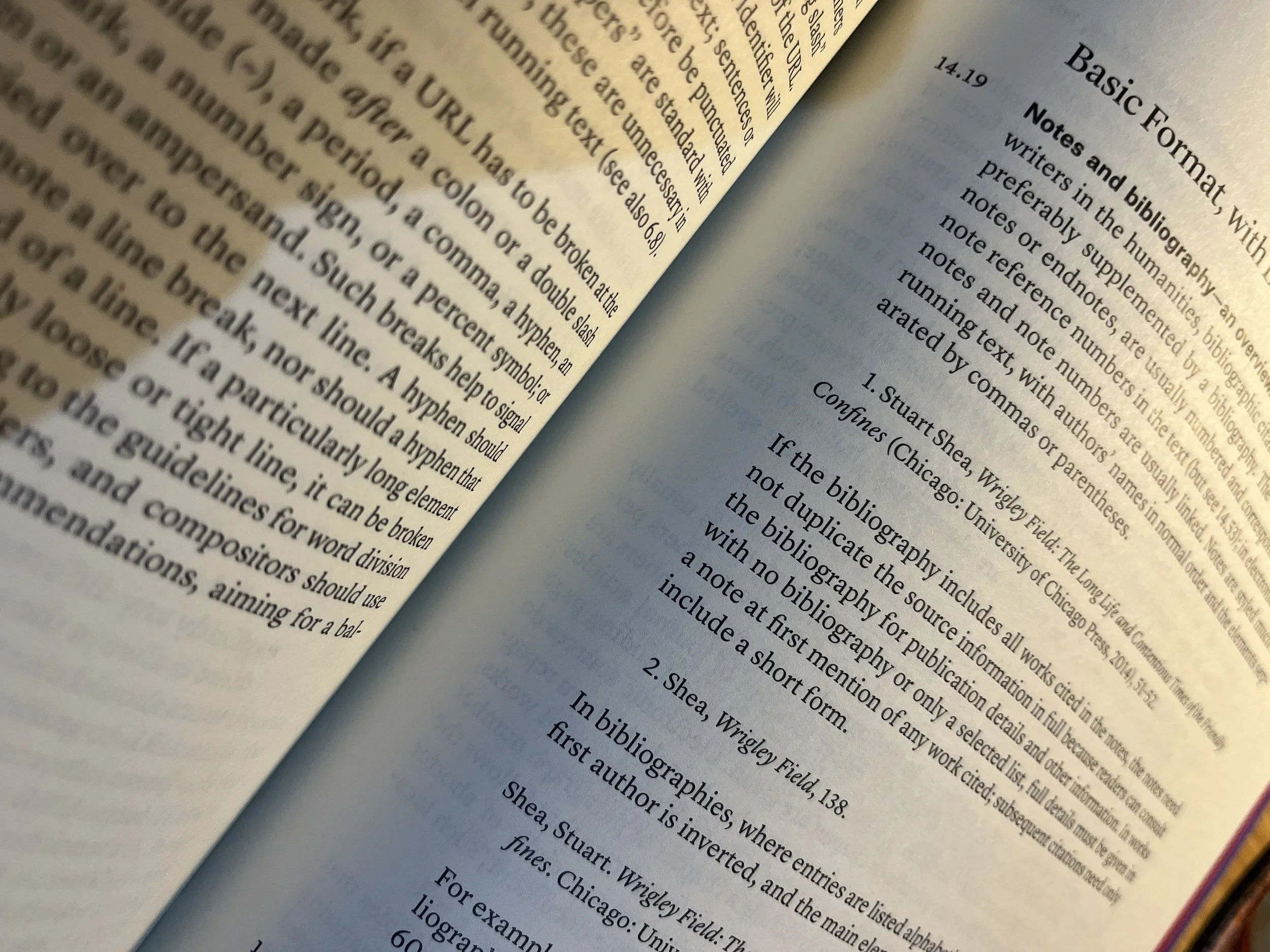
What are notes?
A note is a small number in your text (like this one.¹) that points to a short entry telling the reader where the information came from. Notes come in two kinds:
Footnotes appear at the bottom of the same page.
Endnotes are gathered together at the end of each chapter or at the back of the book. Many trade nonfiction books use endnotes because footnotes can clutter a page. Your publisher will tell you which they prefer.
Each note tells the reader who wrote the source, what it’s called, who published it and when, and which page the information is on. The first time you cite a source, the note gives all of those details. That’s the full note. Every time after that, you can use a shortened note: the author’s last name, a short version of the title, and the page number.
What is a bibliography?
A bibliography is an alphabetical list of the sources you used, placed at the back of your book. Notes point to the exact spot: this claim came from page 45 of this book. The bibliography is the full reading list. A reader can see everything your book draws on in one place.
The two are formatted a little differently:
In a note, the author’s name appears the normal way (Charles Yu), and you include the page number.
In a bibliography, the author’s name is flipped (Yu, Charles) so the list sorts alphabetically by last name, and the page number is left out.
Many books carry both. Chicago allows a book to skip the bibliography if the notes already give full details for every source, so check with your publisher about which they want.
Why does your nonfiction book need them?
Readers can check your work. A reader who’s curious, or skeptical, can follow a note straight to the source.
They give credit. Using someone else’s words, research, or ideas without saying so is plagiarism. Notes are how you say so.
They show where everything came from. A quote that needs permission is much easier to spot when every quote is traced to its source. A note isn’t permission to use the material, but it gives you and your editor the record to check.
They keep your writing readable. The detail lives in the notes, so your paragraphs don’t fill up with parentheses and publication information.
Editors, agents, and reviewers notice. Careful sourcing tells them you did the work.
What is Chicago Style, and why is it used for books?
Chicago Style is a set of rules for writing and citing, published in The Chicago Manual of Style (CMOS) by the University of Chicago Press, now in its 18th edition. It covers citations, but also punctuation, capitalization, numbers, spelling, and more. It’s the standard rulebook for American book publishing, which means most editors, copyeditors, and typesetters already work from it.
It’s used for books because it was built for books. Other styles, like APA and MLA, were designed for journal articles and student papers, where short citations in parentheses work fine. In a book, parentheses all over the page interrupt the reader. Chicago’s notes system keeps the page clean and puts the detail where the interested reader can find it.
That’s why Chicago is the usual choice for history, biography, memoir, narrative nonfiction, and most other trade nonfiction. (Chicago also has an author-date version, mostly used in the sciences. This post covers the Notes and Bibliography system, which is the one you’re most likely to be asked for.)
Why consistency and correctness matter
A citation is a promise to the reader: follow this, and you’ll find what I’m talking about. There are two ways to break that promise.
Incorrect citations send readers nowhere. A wrong page number, a misspelled author, a dead link, or the wrong year, and the reader can’t find the source. Then they start wondering what else in the book is off.
Inconsistent citations look careless. Titles in italics in one note and quotation marks in the next. Full first names in some entries and initials in others. The reader can probably still find the source, but a book that’s sloppy about its sources invites doubt about its facts.
Inconsistency is also expensive. Every mismatch is something an editor has to find, query, and fix, and fixing a few hundred of them at the end of a project takes real time. It’s far easier to get it right from the start.
How to keep your citations clean
Record the details as you read. Author, title, publisher, year, page number, and URL. Going back to find them months later is miserable.
Pick one format and use it for every source. The examples below give you that format.
Check page numbers and links before the manuscript goes to your editor. Links break; page numbers get mistyped.
Ask your publisher or editor about house preferences. Footnotes versus endnotes is the big one.
Chicago Notes and Bibliography: Sample Citations
Here are the most common source types, formatted the way Chicago asks for them. Swap in your own details. Remember: the full note is for the first time you cite a source, the shortened note is for every time after that, and the bibliography entry goes in the list at the back.
Books
Book citations are the most common. In a note, use the author’s name in normal order, the title in italics, the publication information in parentheses (publisher, year), and the page number. In the bibliography, flip the author’s name and leave out the page number.
Good news: CMOS no longer requires the place of publication for books.
Book
Full note: 1. Charles Yu, Interior Chinatown (Pantheon Books, 2020), 45.
Shortened note: 3. Yu, Interior Chinatown, 48.
Bibliography: Yu, Charles. Interior Chinatown. Pantheon Books, 2020.
Chapter in an edited book
Full note: 1. Kathleen Doyle, “The Queen Mary Psalter,” in The Book by Design, ed. P. J. M. Marks and Stephen Parkin (University of Chicago Press, 2023), 64.
Shortened note: 2. Doyle, “Queen Mary Psalter,” 65.
Bibliography: Doyle, Kathleen. “The Queen Mary Psalter.” In The Book by Design, edited by P. J. M. Marks and Stephen Parkin. University of Chicago Press, 2023.
In the edited chapter example, the chapter title goes in quotation marks and the book title goes in italics.
Ebooks and other electronic formats
If you read the book in an electronic format, such as on a Kindle or through an online database, add the format or database name at the end.
Kindle or other ebook: Ebooks often don’t have fixed page numbers, so cite a chapter or section number instead, and add the format.
Note: 1. Arundhati Roy, The God of Small Things (Random House, 2008), chap. 6, Kindle.Online database: Add the name of the database.
Bibliography: Borel, Brooke. The Chicago Guide to Fact-Checking. 2nd ed. University of Chicago Press, 2023. EBSCOhost.
Journal articles
Journal citations include the volume and issue number, which help the reader locate the article. For online articles, use the DOI (Digital Object Identifier) when there is one. A DOI is a permanent link to the article, so it’s more reliable than a regular web address.
Journal article
Full note: 1. Hyeyoung Kwon, “Inclusion Work: Children of Immigrants Claiming Membership in Everyday Life,” American Journal of Sociology 127, no. 6 (2022): 1842–43, https://doi.org/10.1086/720277.
Shortened note: 5. Kwon, “Inclusion Work,” 1851.
Bibliography: Kwon, Hyeyoung. “Inclusion Work: Children of Immigrants Claiming Membership in Everyday Life.” American Journal of Sociology 127, no. 6 (2022): 1818–59. https://doi.org/10.1086/720277.
Sources with more than one author
Two authors: list both, in the note and in the bibliography.
Three or more authors: in the note, give the first author followed by et al. (Latin for “and others”). In the bibliography, list up to six authors. If there are more than six, list the first three followed by et al.
News and magazine articles
These are similar to journal articles, but they usually use the full date instead of volume and issue numbers. Page numbers are usually left out of the bibliography.
Note: 1. Dani Blum, “Are Flax Seeds All That?,” New York Times, December 13, 2023, https://www.nytimes.com/2023/12/13/well/eat/flax-seeds-benefits.html.
Bibliography: Blum, Dani. “Are Flax Seeds All That?” New York Times, December 13, 2023. https://www.nytimes.com/2023/12/13/well/eat/flax-seeds-benefits.html.
Web pages, social media, and video
For online sources, capture the title, the owner or sponsor of the site, the date, and the URL.
Web pages
For a simple web page, mentioning the source in your text is sometimes enough. If you need a formal note, it looks like this.
Note: 1. “Privacy Policy,” Privacy & Terms, Google, effective November 15, 2023, https://policies.google.com/privacy.
Bibliography: The entry is listed under the owner or sponsor of the site. Google. “Privacy Policy.” Privacy & Terms. Effective November 15, 2023. https://policies.google.com/privacy.
Social media
Posts are usually cited in a note only, not in the bibliography. Use the text of the post (up to 280 characters) in place of a title.
Note: 1. NASA Webb Telescope (@NASAWebb), “👀 Sneak a peek at the deepest & sharpest infrared image of the early universe ever taken . . . ,” Twitter (now X), July 11, 2022, https://twitter.com/NASAWebb/status/1546621080298835970.
Videos and podcasts
Include the creator, the title, the platform, the full date, and the time stamp if you’re pointing to a specific moment.
Note: 1. Vaitea Cowan, “How Green Hydrogen Could End the Fossil Fuel Era,” TED Talk, Vancouver, BC, April 2022, 9 min., 15 sec., https://www.ted.com/talks/vaitea_cowan_how_green_hydrogen_could_end_the_fossil_fuel_era.
Bibliography: Cowan, Vaitea. “How Green Hydrogen Could End the Fossil Fuel Era.” TED Talk, Vancouver, BC, April 2022. Video, 9 min., 15 sec. https://www.ted.com/talks/vaitea_cowan_how_green_hydrogen_could_end_the_fossil_fuel_era.
The takeaway
Notes tell the reader exactly where a claim came from. The bibliography lists everything you drew on. Chicago gives you one consistent system for both, built for the way books are read and published.
Get the details right, use the same format every time, and your sources will quietly do their job: your readers will trust you. Keep this page handy while you write, and check the current edition of The Chicago Manual of Style for rarer source types and trickier cases.